
Bulk URL Opening Made Easy
This article provides a comprehensive overview of how bulk link management tools can revolutionize your daily digital workflow. We will explore the common inefficiencies associated with manual web navigation and introduce a dedicated solution designed to eliminate repetitive browser tasks. By examining the core features, practical use cases, browser optimization techniques, and built-in privacy measures of modern tab-opening utilities, this guide will equip you with the knowledge to significantly enhance your productivity when handling multiple web addresses simultaneously.
Navigating the modern internet often requires juggling a massive amount of information at once. For many professionals and casual users alike, the web browser is the central hub of daily operations. Whether you are conducting academic research, performing digital marketing audits, or simply catching up on daily news feeds, you frequently find yourself needing to access dozens of different websites. Historically, this process has been incredibly tedious. The traditional method involves manually copying a web address from a document or spreadsheet, opening a new tab in your browser, pasting the address into the address bar, and hitting enter. When this sequence must be repeated twenty, fifty, or even a hundred times, it becomes a severe bottleneck in your daily productivity. This repetitive action not only consumes valuable time but also breaks your concentration, forcing you to focus on the mechanics of navigation rather than the actual content you need to analyze.
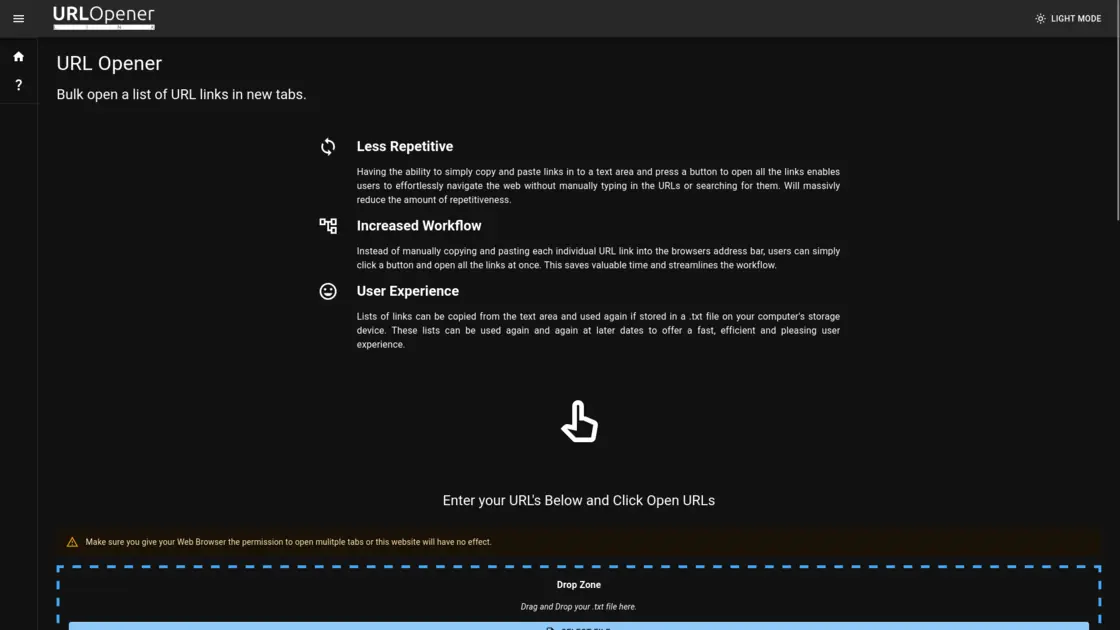
To solve this persistent problem, developers have created specialized online utilities designed specifically to handle bulk link processing. One of the most effective and user-friendly platforms available for this task is https://urlopener.link. This streamlined web application is engineered to take the friction out of mass web navigation. By providing a centralized text area where users can input large lists of web addresses, the platform allows you to launch all of them simultaneously with a single click. Instead of wasting minutes on manual data entry, the tool handles the heavy lifting instantly, freeing you to focus entirely on your work.
What sets this specific platform apart from basic scripts or browser extensions is its thoughtful array of features tailored to optimize both the user experience and device performance. The interface is intentionally minimalist, ensuring that there is no steep learning curve for new users. You are immediately presented with a large input field where you can paste your copied links, ensuring each link is placed on a separate line. For users who maintain permanent lists of essential daily websites—such as morning reading lists or specific server monitoring dashboards—the platform offers a highly convenient drag-and-drop zone. Users can simply drag a standard text file containing their URLs directly into the browser, and the system will automatically parse and populate the list.
A particularly vital feature of the platform is the built-in delay function. When you command a web browser to open thirty tabs simultaneously, the sudden influx of network requests and rendering tasks can easily overwhelm your computer's memory and processing power. Browsers must download HTML, CSS, JavaScript, images, and third-party tracking scripts for every single tab. Attempting this all in a single instant frequently results in browser crashes, frozen screens, and a frustrating loss of work. The delay feature addresses this hardware limitation elegantly. By allowing users to specify a time delay—measured in seconds—between each link opening, the tool gives the browser adequate time to process and load individual pages before the next one is requested. This staggered approach ensures system stability and a smooth browsing experience, even when processing massive lists of complex, asset-heavy websites.
Privacy and data security are also major concerns when utilizing third-party web tools, especially for corporate users dealing with sensitive internal links or client domains. The architecture of this utility is built with privacy at the forefront. While it utilizes the browser's internal memory to facilitate the opening process and potentially save user preferences, it strictly avoids storing your inputted links on any external servers. Your data is not harvested, analyzed, or stored in a remote database accessible to third parties. Once you close your browser session, your lists remain entirely your own, ensuring that proprietary workflows and confidential research targets are completely secure.
The applications for such a utility span across a vast multitude of modern professions. In the realm of Search Engine Optimization (SEO) and digital marketing, professionals frequently export extensive lists of backlinks, competitor pages, or redirect chains from analytical software. Manually verifying these pages is an industry standard but notoriously time-consuming. By utilizing a bulk tab opener, marketers can launch entire batches of URLs, rapidly auditing pages for correct meta tags, indexing status, or content quality. Similarly, academic researchers and journalists who compile extensive bibliographies or source lists can instantly load all their reference materials at the beginning of a working session, creating an immediate digital library ready for cross-referencing.
Even outside of specialized professional fields, everyday users can find immense value in bulk link management. Consider the process of online shopping or deal hunting, where consumers might want to compare prices for a specific product across a dozen different retail websites. A pre-compiled text file of search queries on various storefronts can be dragged into the opener, instantly loading a comprehensive price comparison environment. IT support technicians also utilize these methods to instantly open arrays of router administration panels, diagnostic dashboards, and ticketing systems the moment they begin their shift, establishing their required digital environment in seconds rather than minutes.
To utilize these tools effectively, users must be aware of default browser security settings. Modern web browsers are universally equipped with strict popup blockers designed to prevent malicious websites from spamming users with unwanted advertisements. Because a bulk link opener operates by programmatically commanding the browser to open multiple new windows or tabs, it inherently triggers these defensive mechanisms. Before executing a large list of links, users must ensure they have granted the specific domain permission to open multiple tabs. Usually, this involves clicking a small notification icon in the browser's address bar upon the first attempt and selecting the option to always allow pop-ups and redirects from the specific utility. Failing to configure this permission will result in only the very first link in the list opening, while the remainder are silently blocked by the browser.
Furthermore, users should be mindful of their own hardware specifications. While the delay feature significantly mitigates the risk of crashing, opening a hundred video streaming pages or heavy web applications will eventually consume all available Random Access Memory. It is generally advisable to process vast quantities of links in manageable batches—perhaps twenty to thirty at a time—depending on the capabilities of the computer being used. This balanced approach guarantees both workflow efficiency and system reliability.
In summary, the transition from manual link entry to automated bulk opening represents a fundamental upgrade in how we interact with the web. By eliminating the repetitive strain of continuous copying and pasting, mitigating hardware limitations through intelligent loading delays, and ensuring absolute data privacy, tools designed for this purpose have become essential assets in the modern digital toolkit. Whether you are streamlining complex professional tasks or simply optimizing your daily web routine, integrating a dedicated bulk link manager into your workflow is a guaranteed method for maximizing your time and maintaining focus in an increasingly complex digital landscape.